

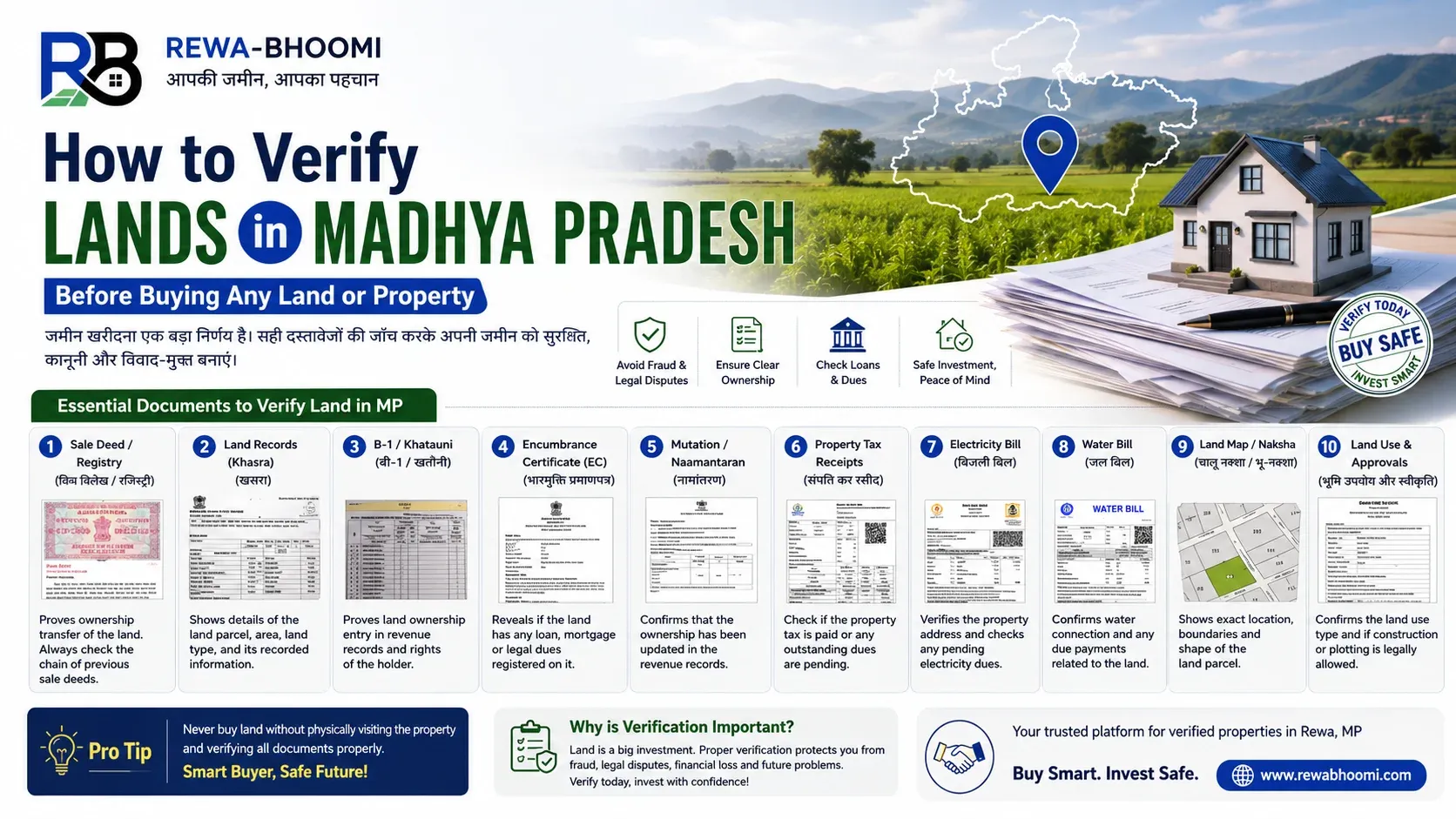
How to Verify Land in Madhya Pradesh Before Buying
Buying a plot or land is one of the biggest financial decisions you can make. A property may look perfect on-site, but its ownership, land records, road access, land use, outstanding dues or approvals may tell a different story.
Before buying land in Madhya Pradesh, do not rely only on the seller's words or a single registry document.
You should compare information from multiple records and, where necessary, get the documents reviewed by a qualified property lawyer or other appropriate professional.
Why Should You Verify Land Before Buying?
Imagine that a seller tells you:
"This land belongs to me. The registry is ready. You can buy it."
That is not enough.
Before purchasing land, you should try to answer these questions:
Is the seller actually entitled to sell the property?
Does the seller's name match the relevant land records?
Does the Khasra number match the Sale Deed?
Does the land area match across the documents?
Has the relevant ownership-related revenue entry been updated?
Is there any registered mortgage or other encumbrance?
Does the physical location match the land map?
Is the land being used for a legally permitted purpose?
If it is a plotted colony, are the required permissions and layout approvals available?
Are there outstanding property-related dues?
Proper verification can help reduce the risk of fraud, disputes and unexpected financial problems.
1. Sale Deed / Registry
In Madhya Pradesh, a Sale Deed is commonly referred to as a Vikray Vilekh or Vikray Patra. In everyday language, people usually call it a Registry.
A Sale Deed is the registered document that records the sale transaction between the seller and buyer.
What Should You Check?
Check the following details:
Seller's name
Buyer's name
Khasra number
Property area
Property boundaries
Village and Tehsil details
Registration details
Document number and date
Previous ownership references
Sale consideration and other relevant details
Why Is It Important?
Do not look only at the current seller's Sale Deed.
For example:
Owner A → Owner B → Current Seller → You
You should understand the relevant chain of title and verify the previous ownership documents where applicable.
Important: A Sale Deed should not be treated as the only document required for complete title verification. Other land records, previous documents and legal checks should also be considered.
2. Khasra / Land Record
In Madhya Pradesh, this is commonly called Khasra or Chalu Khasra.
Khasra is an important land record used to identify and describe a particular land parcel.
Depending on the record, you may find information related to:
Khasra number
Land area
Village
Tehsil
Land classification or use-related information
Recorded holder or rights-related information
Other revenue-record entries
Why Should You Check It?
Suppose the seller says:
"Your plot is in Khasra No. 125/2."
You should compare this Khasra number with the Sale Deed, B-1/Khatauni, map and other relevant records.
The Khasra number, area and location-related details should be consistent across the documents being verified.
3. B-1 / Khatauni
In Madhya Pradesh, this is commonly known as B-1 or Khatauni.
B-1/Khatauni is an important revenue record containing information related to landholding and recorded rights or holders associated with the land.
What Should You Check?
Check information such as:
Recorded holder information
Khasra details
Land area
Revenue-record entries
Other relevant land information
Why Is It Important?
B-1/Khatauni provides another important source for cross-checking the land records against the Sale Deed and other documents.
Important: B-1/Khatauni should not be considered the only proof of legal title. It should be checked together with registered documents and other relevant records.
4. Mutation / Naamantaran
In Madhya Pradesh, Mutation is commonly called Naamantaran.
When ownership-related information needs to be updated in revenue records after a sale or another applicable event, the process is generally referred to as Mutation or Naamantaran.
Why Should a Buyer Check It?
Suppose:
Ram → sells land → Shyam
You should check whether the relevant revenue records have been updated after the transaction.
This helps you understand the current status of the relevant revenue-record entry.
Important: Mutation is not the same as creating legal title. Mutation should be treated as one part of the overall property verification process.
5. Encumbrance / Loan / Mortgage Check
An encumbrance generally refers to a registered burden, charge or other recorded interest affecting a property.
Examples may include:
Registered mortgage
Bank loan or security interest
Certain registered claims
Other registered transactions affecting the property
Why Is It Important?
Imagine the seller says:
"The land is completely clear."
But the property has a registered mortgage.
That is why buyers should investigate relevant registration and encumbrance records before completing a property purchase.
Important: An encumbrance search is not a substitute for complete title verification. Other possible issues, including litigation or unregistered claims, may require separate legal checks.
6. Property Tax
In Madhya Pradesh, property tax is commonly called Sampatti Kar.
If the property falls under an applicable urban or local-body tax system, check the latest property-tax information and receipts.
What Should You Check?
Property details
Taxpayer name
Property identification details
Paid or unpaid status
Outstanding dues
Latest tax receipt
Why Is It Important?
You do not want to discover after purchasing the property that there are unpaid property-related dues.
Important: A property tax receipt is not, by itself, proof of ownership.
7. Electricity Bill
An electricity bill can be useful for cross-checking property and connection details, but it is not an ownership document.
What Should You Check?
Consumer number
Connection name
Address
Meter details
Outstanding electricity dues
Why Is It Useful?
It can help you cross-check the property address and identify any pending electricity-related dues.
Important: The name on an electricity connection does not necessarily mean that the person is the legal owner of the property. A tenant or occupier may also have a utility connection.
8. Water Bill
A water bill can also be useful for checking connection and payment information.
What Should You Check?
Consumer number
Name
Property or address details
Connection information
Outstanding dues
A water bill can help with address and dues verification, but it should not be treated as proof of legal ownership.
9. Land Map / Naksha
In Madhya Pradesh, you may commonly hear terms such as Chalu Naksha or Bhu-Naksha.
A land map helps you understand the location and configuration of a land parcel in relation to surrounding parcels.
What Should You Compare?
Compare the map with:
Khasra number
Property boundaries
Adjacent land
Road access
Physical location
Shape of the land parcel
Why Is It Important?
Suppose a seller shows you a piece of land and says:
"This is your plot."
Do not rely only on what is physically shown to you.
The relevant map and land records should correspond to the property being sold.
10. Land Use & Property Approvals
This is one of the most important checks, especially when buying a plot in a colony or purchasing property for construction.
Owning land does not automatically mean that every type of development or construction is permitted on it.
Depending on the property, location and applicable rules, you may need to check:
Land-use classification
Development permissions
Approved layout
Colony development permission
Building plan approval
Other applicable permissions
Why Is Land Use Important?
A seller may say:
"This is a residential plot and you can build a house here."
Do not rely only on the seller's statement.
Check the applicable land-use information and required development or building permissions for the property.
What If You Are Buying a Plotted Colony?
If you are buying a plot in a developed or newly developed colony, additional verification may be required.
You may need to check:
Approved layout plan
Colony development permission
Developer or colonizer-related permissions
Road and access provisions
Land-use compatibility
Development-related permissions
Other approvals applicable to the project
Do not assume that every plot advertised as a "residential plot" is automatically approved for construction.
Don't Forget Physical Verification
Documents are important, but you should never verify a property only on paper.
Visit the property yourself.
Check the Location
Does the property actually exist where the documents indicate?
Check the Boundaries
Do the physical boundaries match the relevant records and map?
Check Road Access
Is there proper access to the property?
Check the Area
If the transaction involves significant money, consider getting the property measured by an appropriate professional.
Check the Neighbouring Properties
Compare the surrounding land parcels with the relevant map and documents.
The Most Important Cross-Check
Do not check every document separately.
Match the information between the documents.
For example:
Sale Deed
↓
Khasra Number
↓
B-1 / Khatauni
↓
Mutation
↓
Land Map / Naksha
↓
Physical Property
The relevant details should make sense together.
For example, if the Sale Deed mentions Khasra No. 125/2 but the map or physical location points to a different parcel, stop and investigate the difference before proceeding.
Common Mistakes Buyers Make
1. Checking Only the Registry
A registry alone is not enough for complete property due diligence.
2. Trusting Only Seller-Provided Documents
Where possible, verify important information through appropriate official records and sources.
3. Ignoring Previous Ownership
Do not look only at the current seller. Check the relevant ownership history.
4. Not Checking the Khasra Number
A mismatch in the Khasra number can create serious problems.
5. Assuming Utility Bills Prove Ownership
Electricity and water bills are useful for cross-checking connections and dues, but they are not ownership documents.
6. Ignoring Land Use
Different types of land can have different permitted uses and applicable restrictions.
7. Buying a Plot Without Checking Approvals
If you are buying a plot in a colony or project, check the applicable layout and development permissions.
8. Not Visiting the Property
The documents and the actual property should be consistent.
9. Paying a Large Token Amount Too Early
Complete appropriate due diligence before making a major financial commitment.
Land Verification Checklist for Madhya Pradesh
Before buying land, check the following:
☐ Sale Deed / Registry
☐ Previous Sale Deeds / Relevant Title Chain
☐ Khasra / Chalu Khasra
☐ B-1 / Khatauni
☐ Mutation / Naamantaran
☐ Encumbrance / Registration Search
☐ Applicable Loan or Mortgage Release Documents
☐ Property Tax Information
☐ Electricity Dues
☐ Water Dues
☐ Chalu Naksha / Bhu-Naksha
☐ Land-Use Information
☐ Approved Layout, where applicable
☐ Colony Development Permission, where applicable
☐ Building Plan / Building Permission, where applicable
☐ Physical Site Verification
☐ Road and Access Verification
Final Advice
Buying land is not just about finding a good location and negotiating a good price.
You should verify the title, land records, Khasra, B-1/Khatauni, mutation, encumbrance or registration records, map, land use and applicable approvals before completing the purchase.
If the transaction involves significant money or the property has a complicated ownership history, consider getting the documents reviewed by a qualified property lawyer before signing an agreement or making a major payment.
A few hours of verification can save you from years of legal and financial problems.
Buy Smart. Invest Safe.
REWA-BHOOMI
आपकी जमीन, आपकी पहचान